
First ever July cut of silage: Beast barley is on the move at Blyth
Rain, coupled with warm weather, has been a winner for the Zweck family, Blyth, as they restock silage supplies for their milking herd.
Planted on March 20, a paddock of Beast barley is coming out in head, standing nearly a metre tall in some spots, and Justin Zweck, Donava Holsteins, is eager to see the results.
With 212 millimetres of rain so far for 2026, their first cut of silage should happen in two to three weeks' time.
Mr Zweck said they had capitalised on warmth and early rainfall.
"When we got that early rain, February was a bit too early (to sow), so we sowed it mid-March, and then flukishly we got another 25mm on a 1mm forecast, about five days after I sowed it," Mr Zweck.
"It just leaped out of the ground."
At the time of planting Mr Zweck, used "normal seeding rates" of 70 kilograms of seed and 80kg of fertiliser (24:16 dap and urea blend) a hectare.
Three months on and Mr Zweck thinks it could potentially yield four tonnes of dry matter a hectare.
They will need about a four-day window of opportunity to cut.
He said they will mow the silage, let it wilt on the ground for 24 to 48 hours before a self-propelled chopper cuts it to about one-inch high.
Mr Zweck said they aimed to cut the silage at about 65 per cent moisture.
"We would normally spray it out and leave it, but with this paddock this year, because we're still reasonably early, if we chop it in the next few weeks, I'll probably just reseed in between, interrow sow it again and not spray it out and just see what happens."
With any luck, and with all the moisture still around, Mr Zweck hoped it would come up for later in the season and if it doesn't he will spray it out, giving him "good cover" for next year.
"It's the first time I'll ever cut silage in July. Last year was good quality, just not a lot of it. I'm expecting good quality this year."
Each year, the Zweck's cut 200ha of cereal silage, with a further 150-200ha of vetch silage.
They are currently milking 300 Holstein cows, and running replacement heifers and beef crossbreds - close to 800 in total.
They aim to be as self-sufficient with grain and hay as possible as well, having finished their overall seeding program on May 20.
"On an average rainfall year we should grow enough feed for 12 months... so hopefully we get lots more rain and some massive crops," Mr Zweck said.
"Last year, we got lucky. We were probably just a touch under average.
"Considering we had just under 200mm for the year, we got pretty lucky. We grew a reasonable crop for the rainfall."
However, in 2024 they received 190mm of rain, 90 of which fell in October when it was too late.
"So that was just about a write-off. Barley silage didn't even get above my ankle - about a ton a hectare."
"We are loving it (the rain), not complaining at all."
Further Information
By Chelsea Ashmeade | June 22 2026
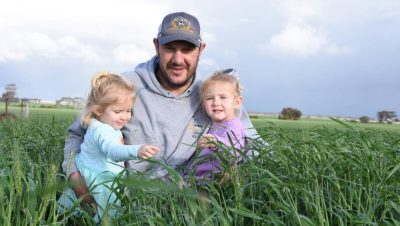
Justin Zweck, Donava Holsteins, Blyth, with three-year-old twin daughters Hazel and Maeve, amongst the nearly ready barley silage crop. Pictures by Chelsea Ashmeade.